
In a proud moment for Indian healthcare and dental research, the largest global oral epithelial dysplasia (OED) study has been officially recognized by the Asia Book of Records. The groundbreaking study brought together 60 oral pathologists from across the world to assess and grade standardized histopathology slides of oral epithelial lesions — a condition known for its potential to progress to oral cancer and its notoriously subjective diagnosis.
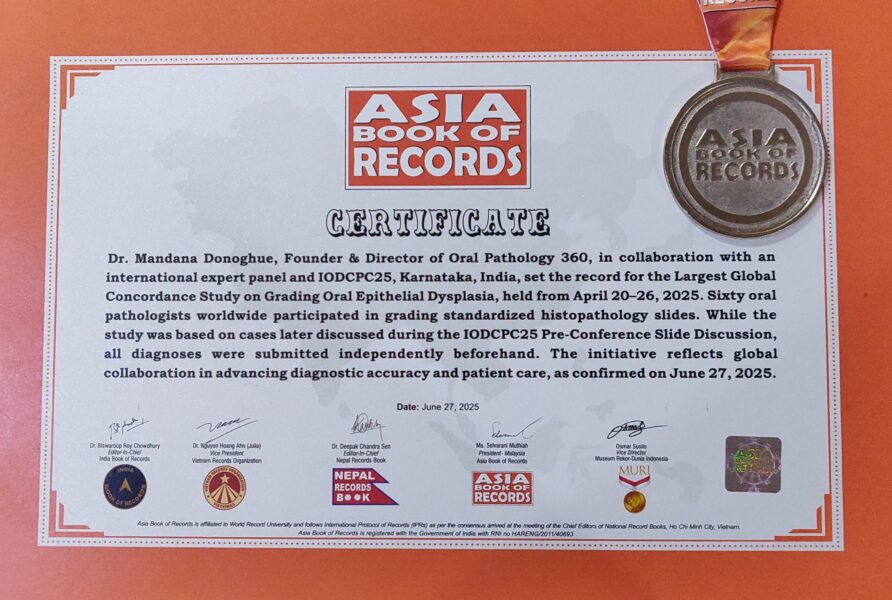
This unprecedented global initiative was coordinated by Dr. Mandana Donoghue, Founder & Director of Oral Pathology 360, and hosted during the IODCPC25 (International Oral Diseases Case Presentation Conference 2025), a virtual academic conference based in Belgaum, Karnataka, India.
A Study of Global Relevance
Oral epithelial dysplasia grading remains one of the most challenging and variable aspects in oral pathology. Disagreement among experts is common — and yet accurate diagnosis is crucial for determining management strategies and predicting malignant transformation risk.
This study sought to evaluate diagnostic concordance among pathologists on key cases. The slides, prepared in advance and shared digitally, were independently reviewed by participants before being discussed during the conference’s pre-conference session. The results are now being developed into a collaborative scientific paper under the guidance of a global expert panel.
Innovation in Methodology
What sets this record apart is not just the scale, but the methodology.
In traditional research settings, assembling 60 pathologists from multiple countries would take months or even years, and require substantial funding and institutional coordination.
Instead, by leveraging:
- a global virtual conference platform,
- digital slide sharing tools, and
- an already-engaged academic community,
the study was completed in a matter of days — demonstrating how academic gatherings can double as research platforms, and how technology can make once-impractical research feasible.
Why It Matters
This record is more than a trophy — it is a statement of what’s possible.
It shows that India is at the forefront of rethinking how global, collaborative research can be conducted in the digital era. It highlights that oral pathology, often underrepresented in mainstream medical research discussions, is capable of innovation, leadership, and global cooperation.
It also spotlights the need to better understand and manage precancerous conditions like oral epithelial dysplasia — something that affects thousands worldwide, especially in regions with high tobacco use.
The Role of Oral Pathology 360
Founded by Dr. Donoghue, Oral Pathology 360 is a pioneering digital platform that connects clinicians, researchers, and educators across the world through:
- livestreams and journal clubs,
- international open mic contests,
- diagnostic masterclasses, and
- collaborative research initiatives.
This record-setting study exemplifies the platform’s mission: to combine learning with impact, and to reimagine how we engage with oral and maxillofacial disease worldwide.
Looking Ahead
A new initiative, Oral Health 360, has also been launched to extend the reach of this work to public health audiences — bridging the gap between research, clinical practice, and public awareness.
As this study moves toward publication, its bigger legacy may lie in the message it sends:
that collaboration, technology, and intent can transform the way we conduct research — not just in oral pathology, but across all of health sciences.