By Oral Pathology 360 | Published on October 10, 2025 — World Mental Health Day
The Hidden Cost of Tough Training
Health-sciences education has always been demanding — and rightly so.
We are preparing doctors, dentists, nurses, and therapists to make critical decisions, manage complex conditions, and shoulder immense human responsibility. The intensity is designed to build resilience and instill mastery of knowledge and skills that patients will one day depend on.
But the same structure that ensures competence can, at times, stretch emotional limits. More students today are struggling to cope, and an increasing number of young professionals are experiencing burnout early in their careers. Mental health in health sciences education is possibly at its worst today.
As we observe World Mental Health Day, it’s time to ask: Are we strengthening and educating our students — or exhausting them before they begin to heal others?
The Reality Behind the White Coats
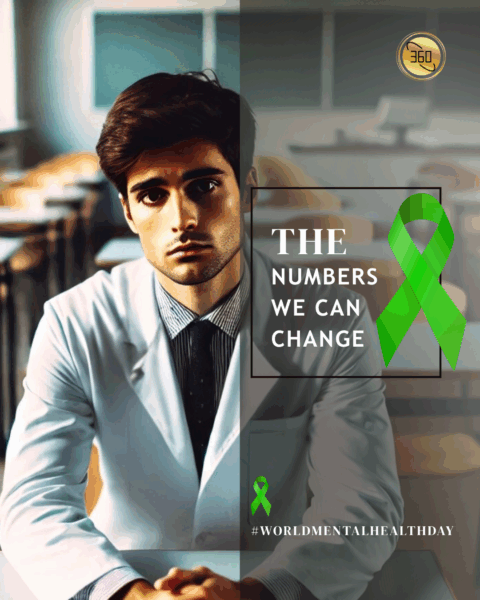
Recent data paints a sobering picture:
In India, 12% of students have experienced suicidal thoughts, and 5% have attempted suicide in the past year (India Today Insight, 2025, “Survey shocker: One in 10 Indian students suicidal; some even attempted it.”) [1].
More than 35 students die by suicide every day across the country (Student Suicides in India – An Analysis of NCRB Data 2017–2023) [2].
Studies from different Indian medical institutions report that between 25% and 40% of students show signs of depression — rates significantly higher than in the general population (Kumar SG et al., 2017, “Depression, anxiety and stress levels among medical students in India,” Indian J Psychol Med, 39(3):273–277) [3].
Globally, depression affects nearly one-third of medical students.(Puthran R., Zhang M.W.B., Tam W.W., Ho R.C., 2016, Medical Education, 50 (4): 456–468*) [4].
These are not isolated numbers — they represent colleagues, classmates, and future caregivers.
Why the Pressure Feels Different Now
The challenges of training have not changed — but the world around our students has:
- Fierce competition makes every grade, internship, and opportunity feel like a survival test.
- Changing family structures means less emotional cushioning and fewer safe outlets for stress.
- Social-media comparison loops amplify feelings of inadequacy and isolation.
- Cultural expectations still equate vulnerability with weakness, especially in healthcare.
Today’s students are not weaker — they are navigating pressures that are more complex, constant, and public than ever before.
From “Tough It Out” to “Talk It Out”
Endurance and intellectual rigor have long been the twin foundations of health sciences training.
But toughness without support is not resilience — it’s attrition.
True resilience grows when intellectual challenge is paired with emotional safety, open dialogue, and space for recovery. Faculty and peers who recognize distress early, normalize open conversations, and guide students toward help can make a life-changing difference.
Faculty: The First Line of Awareness
As educators, we see our students at their best and their most vulnerable. A quiet withdrawal, missed assignment, or sudden drop in participation can be more than academic indifference — it can be a cry for help.
Listening, checking in, or simply acknowledging a student’s struggle can begin a chain of hope.
Join the Conversation
💬 Faculty Development Webinar
Recognizing Early Warning Signs of Depression & Suicidal Ideation in Students
🗓 Saturday, October 25, 2025 🕠 17 : 30 – 19 : 00 IST
🎤 Speaker: Dr. Malik Merchant
📍 Online (Zoom) 🎓 Includes certificate + 1-week recording access
💰 Fees: ₹ 200 / USD 8
Let’s build learning spaces where toughness and compassion coexist — where the next generation of healthcare professionals can grow strong without breaking.
Before They Heal Others, We Must Heal Our Training
Every year, the world pauses on October 10 to talk about mental health.
But for those shaping future healers, awareness cannot be an annual observance — it must be a daily practice.
Because the strength that saves lives should never be the same strength that costs one.
References
- India Today Insight. Survey shocker: One in 10 Indian students suicidal; some even attempted it. Mar 10 2025.
- IC3 Institute. Student Suicides in India – An Analysis of NCRB Data 2017–2023. Sep 2023.
- Kumar SG et al. Depression, anxiety, and stress levels among medical students in India: A cross-sectional study. Indian J Psychol Med. 2017; 39(3): 273–277.
- Puthran R, Zhang MWB, Tam WW, Ho RC. Prevalence of depression amongst medical students: A meta-analysis.Medical Education. 2016; 50(4): 456–468.